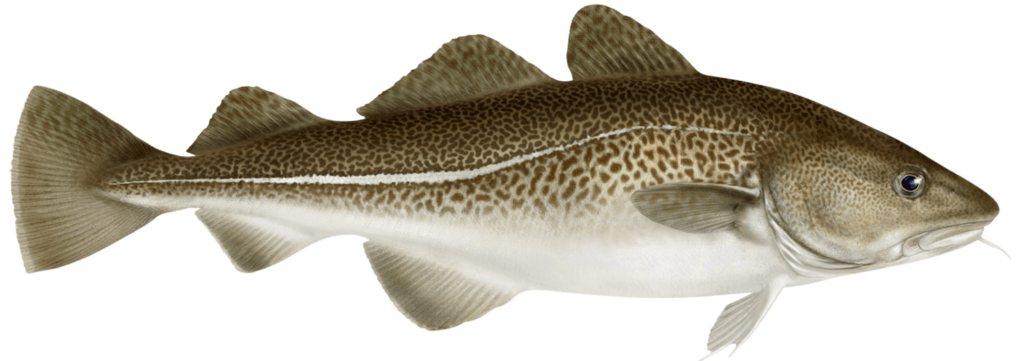
Torsk
Kartan visar de områden där arten förekommer. Observera att detta kan skilja sig från de områden där bedömningar har gjorts för arten.
Karta över hav och sjöar
Karta över Ices-områden
Torsk 2024
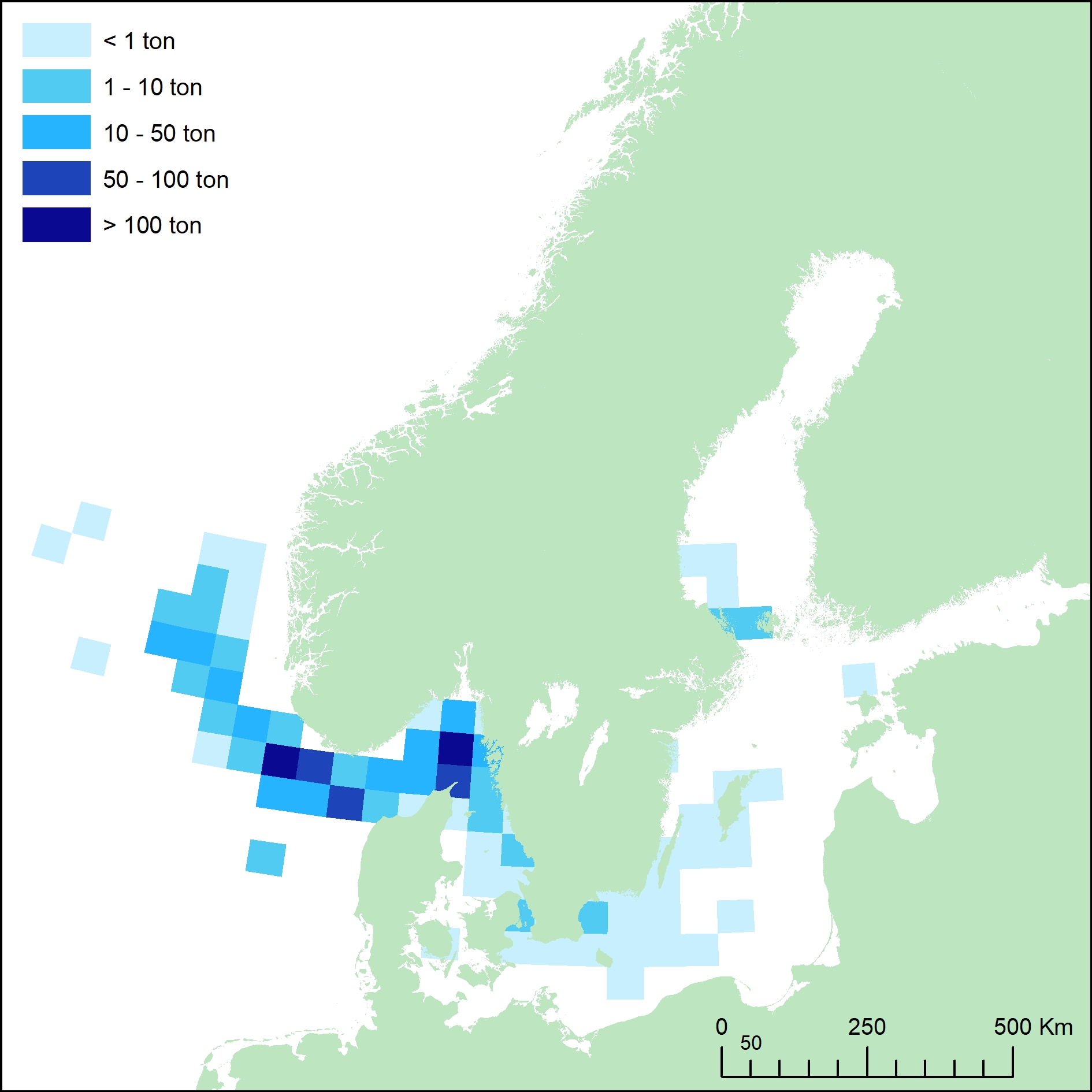
Svenska yrkesfiskares huvudsakliga landningar (ton) av torsk 2023 per Ices-rektangel. En Ices-rektangel är cirka 56 km x 56 km stor.
Bestånds- och populationsstruktur
Torsken förekommer i alla hav som omger Sverige, men är dock relativt sällsynt i Bottenviken och norra Bottenhavet.
Internationella havsforskningsrådet (Ices) ger råd om fyra olika torskbestånd i haven runt Sverige. Ices bedömer att det finns två torskbestånd i Östersjön: ett bestånd väster om Bornholm inklusive Bälthavet och Öresund (Ices-delområden 22–24), och ett bestånd öster om Bornholm (Ices-delområden 24–32)1. Bestånden blandar sig med varandra i Ices-delområde 24. Sedan 1996 har Ices betraktat torsken i Nordsjön (Ices område 4), Skagerrak (Ices-delområde 20) och östra engelska kanalen (Ices fångstområde 7.d), och sedan 2023, väster om Skottland (Ices fångstområde 6.a) som ett enda Nordsjöbestånd2. Detta Nordsjöbestånd består av tre reproduktivt isolerade delpopulationer som har en viss rumslig överlappning (kvartal 2–4). De tre delbestånden består av det nordvästra, Viking (leker i Skagerrak och nordöstra Nordsjön) och det södra. Delbestånden har separata lekområden och olika biologiska egenskaper (tillväxt, könsmognad och så vidare)3. Av de tre delbestånden är Viking-delbeståndet det som är av störst betydelse för västerhavets ekosystem och det svenska fisket.
På svenska västkusten finns också ett separat bestånd i Kattegatt (Ices-delområde 21) samt ett antal lokala kustbestånd där detaljerad kunskap om beståndsstatus saknas. Ungtorsk från bestånden i Nordsjön (inklusive Skagerrak), Öresund och Kattegatt har överlappande utbredning på västkusten1.
Biologiskt råd för torsk i Östersjön, västra beståndet (Ices-delområden 22–24)
Internationella havsforskningsrådet (Ices)
Ices fångstråd för torsk från det västra beståndet i Östersjön för 2024 och 2025 är 24 ton för både yrkesfisket och fritidsfisket tillsammans. För 2023 var rådet 943 ton för båda kategorierna. Jämfört med 2023 innebär det senaste rådet en minskning med 97 procent av de rekommenderade fångstmängderna.
Rådet är baserat på försiktighetsansatsen4. Den 97-procentiga minskningen av fångsten, som rekommenderas för 2024 och 2025, beror på en tillämpning av Ices vedertagna rådgivningsregel (så kallad ”HCR-harvest control rule”). Tillämpning av denna generella regel, ger en minskning av fångstrådet eftersom indexet för lekbiomassa visar på en kraftig minskning det senaste året4.

ICES råd om fiskemöjligheter i Östersjön (Ices-delområden 22–24).
Fisket i Ices-delområden 22–24, bedrivs huvudsakligen av Danmark, Polen, Tyskland och Sverige. Danska yrkesfiskare svarar för den största delen av den kommersiella fångsten (50 procent) eftersom de har den största kvoten1, 4. Det svenska yrkesfiskets andel av fångsterna har i medel varit cirka 17 procent åren 1995–2021. År 2022 landades totalt 88 ton, varav det svenska yrkesfiskets officiella landningar utgjorde nio ton 1, 4. Sedan 2022 är riktat fiske efter torsk i västra Östersjön förbjudet, vilket innebär att de begränsade fiskemöjligheterna enbart är avsedda för oundvikliga bifångster av torsk vid fiske efter andra arter, främst plattfiskar. Torsken fångas mest med bottentrål och nät4. Enligt Ices förekommer ett visst utkast (fisk kastad överbord), som ökade jämfört med tidigare år och uppskattades vara nio procent av den totala kommersiella fångsten 20221, 4. Eftersom fritidsfiskefångsterna är betydliga, tas det även hänsyn till detta i beståndsuppskattningen för det västra beståndet. Under 2022, på grund av de mycket låga kommersiella fångsterna, ökade andelen fritidsfiskad torsk från 46 till 71 procent av den totala fångsten, även om den faktiska nivån av fritidsfångster uppskattades vara historiskt låg (288 ton) 4.
År 2023 nedgraderades torsken från västra beståndet i Östersjön från bedömningskategori ett (fullt analytisk) till kategori tre (databegränsad). Orsaken till nedgraderingen är den stora osäkerheten kring den beräknade fiskeridödligheten (F) i beståndsuppskattningsmodellen, och att endast trenderna för lekbiomassan (SSB, biomassan av könsmogna honor) och rekrytering från modellen anses vara pålitliga, inte de absoluta värdena1.
Modellen som används av Internationella havsforskningsrådet (Ices) bygger på en kombination av kommersiella fångster, fritidsfiskestatistik (Tyskland, Sverige och Danmark) och fiskerioberoende vetenskapliga trålundersökningar (”Baltic International Trawl Survey”, Bits) samt data från provfiske med fasta redskap4.
Osäkerheterna i utvecklingen av SSB och rekryteringsskattningar är relevanta och därför beslutade Ices att presentera SSB och rekrytering som relativa värden och att inte använda fiskeridödligheten från modellen utan i stället använda fångstuttag (relativa fångster/lekbiomassa)1, 4. Den övergripande bedömningen visar att den relativa lekbiomassan sedan 2008 ligger under tröskelvärdet för den lekbiomassa som inte bör underskridas för att ge en maximal hållbar avkastning för ett bestånd (MSY Btrigger). Lekbiomassan har sedan 2015 även varit mindre än den gräns där lekbeståndet anses ha en risk för reducerad förmåga att producera ungfisk (Blim; )4. Den relativa dödligheten (fångst per biomassa) har minskat den senaste åren . Rekryteringen av ung torsk har sedan 2005, med undantag för 2017 och 2023, legat under medelvärdet för perioden 1985–2022 och rekryteringen för åren 2018–2022 är bland de lägsta i hela tidsserien men har ökat under de senaste åren (2023) och visar en positiv trend 4.
Osäkerhet kring fiskeridödligheten tyder på att okända processer, utöver fiskets fångster och antagen naturlig dödlighet, påverkar lekbiomassan för torsk i västra Östersjön1. Källorna till denna okända dödlighet är för närvarande okända, men kan inkludera ökad naturlig dödlighet (till exempel på grund av ökad predation, minskad kondition kopplad till ökad temperatur och syrebrist på sommaren5, migration till östra Östersjön eller till Kattegatt, orapporterade fångster eller ökad lokal/regional dödlighet på grund av syrefria vatten närmare ytan och kusterna). Dock kan effekterna, och storleksordning av dessa olika potentiella påverkansfaktorer för närvarande inte kvantifieras och är därför svåra att ta hänsyn till i bedömningen av beståndets utveckling1.
En kraftig minskning av fiskeansträngningen under senare år, återspeglas inte fullt ut i fiskeridödligheten som på en minskad fångst per fiskeansträngning , för i kontrast till detta mönster uppvisar de vetenskapliga trålundersökningarna en oförändrad hög total dödlighet (naturlig dödlighet och fiskeridödlighet tillsammans. Detta innebär att de totala dödsorsakerna inte har fördelats pålitligt mellan fiskeridödlighet och naturlig dödlighet1, 4.
På grund av nedgradering till en bedömningskategori 3, grundades det nya biologiska rådet i enlighet med Ices nya rådgivningsprinciper (inom Ices ramverk)6 för bedömningar av databegränsade bestånd och på en försiktighetsansats. Fångstrådet för nästa år baseras på fångsterna från 2022 och den relativa SSB från beståndsuppskattningsmodellen innevarande år4. Dessutom tar man hänsyn med denna metod ett empiriskt tröskelvärde för beståndsstorlek som representerar en gräns för den lekbiomassa under vilken beståndets tillstånd skulle försämras till en oönskad nivå (Itrigger). För detta bestånd sammanfaller Itrigger med MSY Btrigger 4.
De biologiska analyserna för västra torskbeståndet visar att konditionen har minskat. Detta kan bero på förändringar i ekosystemet, såsom säsongsmässigt dåliga syreförhållanden i bottenvattnet som kan påverka tillgången på bentisk (bottenlevande) föda och ämnesomsättningen hos torsken negativt. Under sommaren byggs dåliga syreförhållanden upp under språngskiktet i västra Östersjön på grund av övergödning samt ökande temperaturer kopplade till klimatförändringar. Samtidigt begränsar onormalt uppvärmda ytvatten torskens möjligheter att utnyttja dessa livsmiljöer under sommar och höst1, 4.
Ices bedömer att beståndets lekbiomassa ligger under gränsvärdet som inte bör underskridas när beståndet fiskas vid den nivå som ger maximal hållbar avkastning (MSY Btrigger), samt under det tröskelvärde som representerar en gräns för den biomassa under vilken beståndets tillstånd skulle försämras till en oönskad nivå (Itrigger). Beståndet bedöms till och med befinna sig under den gräns för lekbeståndets storlek under vilken det är stor sannolikhet att beståndets förmåga att producera ungfisk minskar (Blim). Inga referenspunkter för fiskeridödligheten på detta bestånd har fastställts4.
Ices har konstaterat att det östra- och det västra torskbeståndet i Östersjön blandar sig med varandra (särskilt i Ices-delområde 24) och troligtvis har beblandningen ökat under senare år7. Beståndstillhörigheten av torsk från västra respektive östra beståndet görs med hjälp av formen på fiskens otoliter (hörselstenar) kombinerat med genetiska undersökningar. År 2022, uppskattades att 34 procent av torsken i Ices-delområde 24 härstammade från det västra beståndet och de senaste fem åren har andelen torsk från det östra beståndet utgjort cirka 70 procent av torsken i Arkonabassängen (Ices-delområde 24)1. I beståndsanalysen anser man numera att det endast är i Bälthavet (Ices-delområde 22) och Öresund (Ices-delområde 23) som torsk från västra beståndet uppehåller sig utan inblandning av torsk från östra beståndet.
På grund av beståndets låga status är inget riktat torskfiske tillåtet utan kvoten är avsedd för oavsiktliga bifångster vid fiske efter andra arter.
När den europeiska kommissionen publicerat fångstmängderna (TAC) kan man hitta dem på deras hemsida, https://oceans-and-fisheries.ec.europa.eu/fisheries/rules/fishing-quotas_en samt på Havs- och vattenmyndighetens hemsida, https://www.havochvatten.se/fiske-och-handel/kvoter-uppfoljning-och-fiskestopp/kvoter-och-fiskestopp.html. Underlaget för beslut, lagstiftning och TAC-förordningar från EU-rätten finns att hitta på Europeiska unionens publikationsbyrås webbportal, EUR-lex, https://eur-lex.europa.eu/homepage.html?locale=sv.
Biologiskt råd för torsk i Östersjön, östra beståndet (Ices-delområden 24–32)
Internationella havsforskningsrådet (Ices)
Ices fångstråd för östra torskbeståndet i Östersjön samt torsk tillhörande östra beståndet som fångas i Arkonabassängen (Ices-delområde 24) för 2025 är noll ton. För 2022, 2023 och 2024 var även rådet noll ton. Rådet baseras på försiktighetsansatsen8.
ICES råd om fiskemöjligheter i Östra och norra Östersjön (Ices-delområden 24–32).
Polen, Danmark och Sverige svarar historiskt för störst fångster av torsk från det östra beståndet. På 1980-talet uppgick fångsterna till cirka 400 000 ton per år och under 2010-talet var de totala landningarna cirka 50 000 ton per år. Därefter har landningarna minskat ytterligare, och sedan 20071 har inte hela EU:s kvot blivit landad, till följd av beståndets dåliga status. Sedan 2019 är kvoten endast avsedd för oundvikliga bifångster vid fiske efter andra arter. De totala landningarna 2023 var 1 008 ton, varav 9 ton från svenska båtar, den lägsta i hela tidsserien. Historiskt har fångsterna av torsk legat på betydligt högre nivåer än dagens; landningarna toppåret 1984 uppgick till över 400 000 ton. Det året var de svenska fångsterna nästan 60 000 ton 1, 8.
Underrapportering av torskfångster har förekommit 1993–1996 samt 2000–20071. Uppskattningarna av underrapporterade landningar är dock osäkra, men under dessa år har Internationella havsforskningsrådet (Ices) valt att inkludera alla uppskattningar av underrapportering som finns tillgängliga. Informationen om felrapporterad fångst kom från källor inom fisket samt fiskerikontroller, dock inte från alla länder som fångar torsk i Östersjön. Beräkningarna från Ices indikerar att fångsterna fram till 2007 varit minst 35–40 procent större än vad som rapporterats. För åren 2008 och 2009 skattades underrapporteringen uppgå till fem procent. Sedan dess har Ices antagit att underrapporteringen har varit liten och ingår numera inte i beståndsuppskattningen1, 8. Rapporterade utkast (fisk kastad överbord) från fisket jämfört med beräknade utkast skiljer sig dock markant vilket innebär att det troligen förkommer underrapportering av fångster även i dag. Utöver införandet av landningsskyldigheten 2015, höjdes samtidigt även minsta referensstorlek för bevarande (MRB) för landad torsk, från 35 cm till 38 cm, vilken gör jämförelser av utkast över tid svåra. År 2023 var mängden utkast cirka sex procent av den totala fångsten8. Provtagning från EU:s fångster och utkast har varit osäkra de senaste åren till följd av en kombination av små fångster och störningar av provtagningen på grund av COVID-19. Uppskattning av utkast för 2023 baseras endast på två fiskeresor från ett land, vilket är en konsekvens av att det inte bedrivs något riktat fiske på torsk. Dessutom fångar Ryssland en betydande del av detta bestånd, men ingen information om dessa fångster har officiellt rapporterats till Ices för åren 2022 eller 20231 och Ices har beräknat att nästan 80 procent av de totala landningarna från beståndet 2023 var ryska. Mängden fångst från Ryssland för 2022 och 2023, som ingick i beståndsuppskattningen, baserades på allmän tillgänglig information. Torsk från det östra beståndet som fångas väster om Bornholm (Ices-delområden 22–24) räknas numera in i fångsterna för det östra beståndet (Ices-delområden 25–32). Därför gäller rådet för Ices-delområden 24–32. Mängden torsk som fångas i västra Östersjön, men som tillhör det östra beståndet, utgör mellan 13–20 procent av den totala fångsten från östra beståndet1, 8. Dessa fångster sker huvudsakligen i östra delen av Arconahavet (Ices-delområde 24).
Från 2014 och fram till 2019 kunde Internationella havsforskningsrådet (Ices) inte genomföra en analytisk beståndsanalys för torskbeståndet i östra Östersjön. Anledningen var att torskarna i det östra beståndet hade blivit svårare att åldersbestämma med traditionella metoder (läsning av antalet årsringar i torskens hörselstenar). Tack vare data från det märkningsprojektet ”Tagging Baltic Cod” (Tabacod) i Östersjön, så kunde torskens tillväxt bestämmas med återfångster av märkta torskar9. Märkningen utfördes under fyra år (2016–2019) i södra och mellersta Östersjön. Totalt märktes cirka 20 000 torskar. Forskare från Sverige, Danmark, Tyskland och Polen deltog i projektet. År 2019 genomfördes en ”benchmark” (grundlig genomgång av tillgängliga data och analysmetoder), för torsken i det östra beståndet10. Detta resulterade i att det östra beståndet återigen fick en analytisk beståndsuppskattning efter flera år med otillräcklig datatillgång. 2024 ansåg Ices återigen att dataunderlaget var undermåligt samt att vissa antaganden i modellen inte var tillförlitliga och således nedgraderades östra torskbeståndet från bedömningskategori ett (fullt analytisk) till kategori tre (databegränsad). Ices bedömer att de senaste årens estimat av rekrytering är mycket osäkra medan man fortfarande bedömer att trenderna är pålitliga för lekbiomassa och en proxy för fiskerimortalitet. Eftersom Ices inte godkänner beståndsuppskattningen (nedgradering till kategori tre) har Ices valt att bara publicera referenspunkter för lekbiomassa för östra torskbeståndet.
Mängden lekmogen torsk (lekbiomassan) har minskat sedan 2014 och har där efter legat under gränsen som innebär risk för en reducerad förmåga att producera ungfisk (Blim) 8. Den relativa fiskeridödligheten (F) har minskat sedan 1990-talet . Rekryteringen (R) har varit relativt god de senaste åren men eftersom modellantaganden angående rekryteringen har ifrågasatts detta år bör man vara försiktig med att uttolka för mycket utifrån dessa trender 8. Konditionen (vikt vid en specifik längd) och längden då fisken blir könsmogen har minskat kraftigt under de senaste årtiondena11. Dessa förändringar visar att torsken är utsatt för stress och har en minskad reproduktionskapacitet12. Den naturliga mortaliteten (annan dödlighet än fiske) har samtidigt ökat under perioden och uppskattas för nuvarande vara betydligt högre än fiskerimortaliteten13. Orsakerna till torskens besvärliga situation i östra Östersjön kan härledas till förändringar i Östersjöns ekosystem som exempelvis dåliga syreförhållanden som kan påverka torsken direkt genom att torskens metabolism förändras och indirekt genom att lämpliga habitat minskar samt att förekomsten av bottenlevande byten minskar i antal14. Både sillen och skarpsillen har förflyttat sig norrut i Östersjön under senare år vilket gör att den inte helt överlappar med torskens utbredningsområde. Detta innebär sannolikt en minskad förekomst av bytesfisk i området där torsken uppehåller sig14. Det har även skett en kraftig ökning av parasitinfekterade torskar i östra beståndet. Ökningen av parasiter i torsken kan relateras till den ökande gråsälspopulationen i Östersjön under senare år15. Det är svårt att särskilja den relativa betydelsen av de olika enskilda faktorerna för beståndets status och utveckling, likaså är det svårt att utvärdera effekterna av eventuella förvaltningsåtgärder.
Ices bedömer att beståndets lekbiomassa ligger under den gräns för lekbeståndets storlek under vilken det är stor sannolikhet att beståndets förmåga att producera ungfisk minskar (Blim) och även under den gräns för lekbeståndets storlek som tar hänsyn till osäkerheten kring Blim (Bpa). Inga referenspunkter för fiskeridödligheten har fastställts för detta bestånd8.
I det östra torskbeståndet sker leken utspritt från april till sen höst i de djupare delarna av Bornholmbassängen och, i mindre utsträckning, i Gotlands- och Gdanskbassängerna och eventuellt i Ålands hav. Historiskt har lek skett i Gotlands- och Gdanskbassängerna1, 6. Anledningen till att lekområdena försvunnit är förändringar i miljöfaktorer såsom låg salthalt och låga syrehalter14, samt ett för stort historiskt fiske.
Ices rekommenderar att bevarande av Östersjötorsken bör övervägas inom ramen för försämringen av ekosystemets status till följd av ackumulerad mänsklig påverkan och klimatförändringar. För att förbättra livsmiljön för torsk rekommenderar Ices åtgärder för att minska övergödning och öka syrehalten vid botten1.
När den europeiska kommissionen publicerat fångstmängderna (TAC) kan man hitta dem på deras hemsida, https://oceans-and-fisheries.ec.europa.eu/fisheries/rules/fishing-quotas_en samt på Havs- och vattenmyndighetens hemsida, https://www.havochvatten.se/fiske-och-handel/kvoter-uppfoljning-och-fiskestopp/kvoter-och-fiskestopp.html. Underlaget för beslut, lagstiftning och TAC-förordningar från EU-rätten finns att hitta på Europeiska unionens publikationsbyrås webbportal, EUR-lex, https://eur-lex.europa.eu/homepage.html?locale=sv.
Biologiskt råd för torsk i Kattegatt
Internationella havsforskningsrådet (Ices)
Ices fångstråd för torsk i Kattegatt för 2025 och 2026 är noll ton. Ices har gett samma råd på (noll ton) sedan 2020 och minimal fångst sedan 2002. Rådet innebär att fångsterna inte bör ökas jämfört med 2023.
Rådet baseras på försiktighetsansatsen eftersom den exakta nivån på fiskeridödligheten och lekbiomassan inte går att bestämma16.
ICES råd om fiskemöjligheter i Kattegatt.
Kattegatt har historiskt varit ett område med stora torsklandningar , men sedan flera år har beståndet kraschat och riktat torskfiske är förbjudet i Kattegatt. Torsk fångas i dagsläget som bifångst i fiske efter andra arter, framförallt med bottentrål efter havskräfta och plattfiskar1, 16. År 1977 fångades 20 000 ton torsk i Kattegatt, varav de svenska landningarna motsvarade 3 400 ton. Landningarna kan jämföras med 2023 då endast 22 ton landades, varav Danmark 13 ton, Sverige 3,2 ton och Tyskland 0,3 ton. Utkast (fisk kastad över bord) 2023 uppskattas till över 90 procent av den totala fångstmängden (i antal) och 63 procent av vikten16.
Historiskt skedde en stor del av torskfisket i Kattegatt under torskens lekperiod under första kvartalet (januari–mars). Vissa år fångades 70–80 procent av kvoten under detta kvartal. Med minskande beståndsstorlek och kvoter minskade fisket på lekande torsk i början av 2000-talet och har i dag helt upphört. Ices har rekommenderat att inget fiske bör ske av torsk i Kattegatt sedan 2002. Under åren 2013–2015 sågs en viss tendens till återhämtning av beståndet, men sedan 2015 har dock beståndet minskat igen och beståndsstorleken 2023 befinner sig på historiskt låg nivå17. Enligt nationella enkätundersökningar, utförda av Havs- och vattenmyndigheten och Statistiskbyrån (SCB), har fritidsfiskets behållna fångster av torsk i Kattegatt uppskattats till mellan 7–206 ton per år för åren 2014–202317.
Utvecklingen av torsk i Kattegatt följs genom provfisketrålningar med svenska forskningsfartyget R/V Svea (”International Bottom Trawl Survey”, IBTS). Sverige, tillsammans med Danmark, genomför också standardiserade provfisketrålningar med hjälp av inhyrda kommersiella fiskebåtar. Data från båda dessa provfisken ingår i Internationella havsforskningsrådet (Ices) bedömning av beståndsstatus. Sverige och andra länder följer också beståndet genom att utföra olika typer av provtagningar av landningar i hamnar och på fångster ombord på kommersiella fartyg16.
Beståndsutvecklingen av torskbeståndet i Kattegatt är baserat på trender från och med 1997. Lekbiomassan (SSB) har minskat sedan startåret 1997 och trots vissa tecken på återhämtning mellan 2013 och 2015 så är nivån på lekbiomassan historisk låg de senaste åren . Den relativa totala dödligheten (Z; summan av naturlig och fiskerirelaterad dödlighet) har ökat sedan den historiskt låga nivån 2014, men minskar återigen de senaste åren . Rekryteringen (R) de senaste sju åren har varit under genomsnittet 1997–2022, och 2024 års rekrytering beräknas vara bland de lägsta som observerats under hela tidsserien 16.
Ices kan inte bedöma beståndsstatus eller fiskeridödlighet baserad på principen om maximal hållbar avkastning (MSY) och försiktighetsansatsen, eftersom inga referenspunkter för fiskeridödligheten och beståndsstorleken för detta bestånd har fastställts. Lekbiomassan (SSB) bedöms dock vara under alla referenspunkter16.
Torskens historiska lekområden i Kattegatt är väldokumenterade och genetiska skillnader har påvisats mellan lekbeståndet i Kattegatt jämfört med bestånden i Nordsjön, Skagerrak och Östersjön18. Lek förekommer fortfarande i vissa områden men några av de tidigare kända lekområdena längs Hallandskusten verkar inte längre vara aktiva18-20. Ett lekområde i södra Kattegatt delas med Öresund men generellt är beståndet skilt mellan Kattegatt och Öresund med lågt utbyte av individer18.
Beståndsmodellen för torsk i Kattegatt är enligt Ices klassad som osäker, vilket är en följd av att fiskeridödligheten är okänd. Det innebär att man endast använder en relativ utveckling av dödlighet, lekbiomassa och rekrytering16. Den huvudsakliga anledningen till osäkerheten är att mängden fisk som årligen beräknas försvinna enligt beståndsmodellen, är betydligt större än den mängd som rapporteras som fångster och som förväntas dö naturligt. Den förmodade huvudorsaken till den bristfälliga överrensstämmelsen är att ung Nordsjötorsk växer upp i Kattegatt för att senare återvända till Nordsjön för lek. Sedan 2015 och framåt genomförs genetiska provtagningar med syfte att kvantifiera den andel av torsk i Kattegatt som tillhör Nordsjö- respektive Kattegattbeståndet i fiskets fångster och i provfisken. Preliminära resultat visar att en del torsk som härstammar från Nordsjön växer upp i Kattegatt tillsammans med den lokala torsken19, 21. I samband med könsmognad (3–4 års ålder), simmar Nordsjötorsken ut till lekplatserna i Nordsjön. Det finns skillnader i Nordsjötorskens utbredning, och i den norra halvan av Kattegatt så är andelen Nordsjötorsk i åldrarna 0–4 år betydande, men söderut är andelen inte lika stor19, 21. Mot bakgrund av torskens kraftiga tillbakagång i Kattegatt sedan 2015, så är andelen Nordsjötorsk i Kattegatt sannolikt större nu än tidigare. Information från de genetiska analyserna används för att förbättra beståndsanalysen på sikt.
När den europeiska kommissionen publicerat fångstmängderna (TAC) kan man hitta dem på deras hemsida, https://oceans-and-fisheries.ec.europa.eu/fisheries/rules/fishing-quotas_en samt på Havs- och vattenmyndighetens hemsida, https://www.havochvatten.se/fiske-och-handel/kvoter-uppfoljning-och-fiskestopp/kvoter-och-fiskestopp.html. Underlaget för beslut, lagstiftning och TAC-förordningar från EU-rätten finns att hitta på Europeiska unionens publikationsbyrås webbportal, EUR-lex, https://eur-lex.europa.eu/homepage.html?locale=sv.
Biologiskt råd för torsk i Nordsjön, väster om Skottland, östra engelska kanalen och Skagerrak
Internationella havsforskningsrådet (Ices)
Under en ”benchmark” (grundlig genomgång av tillgängliga data och analysmetoder) 2023 rekommenderade Ices att slå samman bestånden av torsk i 2. Det nya beståndet inkluderar tre reproduktivt isolerade delpopulationer: det nordvästra, Viking och det södra . Dessa är separerade under lekperioden (kvartal ett) men antas vara fullt mixade resterande del av året2.
Ices rekommenderar för torsk i Nordsjön, väster om Skottland, östra engelska kanalen och Skagerrak när principen om maximal hållbar avkastning (MSY) används, att man bör särskilt skydda det södra delbeståndet (delbeståndet med sämst status). För de två övriga delbestånden bör försiktighetsansatsen användas. Sammantaget bör fångsterna 2025 inte överstiga 15 511 ton, vilket motsvarar 9 920 ton från det nordvästra delbeståndet, 3 343 ton från Viking-delbeståndet och 2 248 ton från det södra delbeståndet22.
Dessa fångstråd per delbestånd, bör inte betraktas som områdesspecifika råd eftersom delpopulationerna efter leken (kvartal ett) antas blandas i hela utbredningsområdet (läs mer under Miljöanalys och Forskning om den ”Benchmark” där detta antagande diskuterades). Ices påpekar också att delar av detta torskbestånd blandar sig med Kattegattorsk i norra delarna av Kattegatt.
ICES råd om fiskemöjligheter i Nordsjön, väster om Skottland, östra engelska kanalen och Skagerrak.
Torsk fångas i Nordsjön, väster om Skottland, östra engelska kanalen, Skagerrak och Östersjön med många olika fångstredskap anpassade för fångst ovan eller på havsbotten, till exempel bottentrål, bomtrål, snurrevad, nät eller krok22. Trålarnas maskstorlek varierar från 70 mm till över 120 mm. Den största delen av fångsterna kommer från fiske med stormaskiga bottentrålar och nät (minst 120 mm), även om torsk också är en vanlig bifångstart i många andra trålfisken såsom till exempel fiske efter havskräfta och nordhavsräka, och i bomtrålsfisken efter plattfiskar. Fisket i detta område bedrivs främst med bottentrål, vanligtvis med en maskstorlek på 120 mm, men i området finns också ett stort trålfiske efter havskräfta med 80 mm maska (90 mm maska i 3a) som får bifångst av små torskar, varav de flesta kastas överbord22, 23.
År 2023 var de totala landningarna 24 924 ton, varav 20 985 ton i Nordsjön, 1 105 ton väster om Skottland, 31 ton i östra engelska kanalen och 2 803 ton i Skagerrak. Från slutet på 1960-talet fram till 1987 låg de totala årliga landningarna av torsk i Nordsjön på över 200 000 ton med toppar på över 300 000 ton. Perioden 1988–1998 var landningarna över 100 000 ton per år. Från 1999 har landningarna varit mindre än 100 000 ton och har sedan 2003 fluktuerat mellan 30 000–40 000 ton. Som ett resultat av minskade fiskemöjligheter har fångsterna de senaste tre åren minskat markant och var 2023 drygt 25 000 ton. Storbritannien (Skottland) och Danmark har varit och är de dominerande fiskenationerna i egentliga Nordsjön. Svenska landningar i Nordsjön låg 1996–1999 mellan 2 000–3 000 ton men var 402 ton 202222, 23. Huvuddelen av de svenska torskfångsterna tas från Viking-delbeståndet. I Skagerrak var landningarna cirka 17 000 ton 1996, och Sveriges landningar motsvarade ungefär 1 900 ton. I likhet med minskningen för beståndet som helhet har de totala landningarna i Skagerrak minskat kraftigt, och de svenska landningarna har varit runt 500 ton under 2010-talet. Svenska fångster var 1 ton 2022 och 2023 var landningarna 377 ton22. Utkast (fisk kastad överbord) fortsätter trots att man infört landningsskyldigheten 2017, baserat på observationer från observatörprogram. Andelen utkast 2023 uppskattades vara 31 procent av den totala fångsten i vikt. Uppskattningar av utkast finns inte tillgängliga på delbeståndsnivå, och därför uppskattas beståndsuppskattningsmodellen totala fångster för delbestånden tillsammans , och .
För beståndet som helhet bedömer Ices att fritidsfiskets fångster utgjort omkring 2,4–6,5 procent av de totala fångsterna för perioden 2010–2023, men värdena är preliminära och ingår inte i bedömningen på grund av okänd åldersstruktur i fritidsfiskets fångster och hög osäkerhet i uppskattningarna. Enligt nationella enkätundersökningar utförda av Havs- och vattenmyndigheten och Statistikbyrån (SCB) har fritidsfiskets behållna fångster av torsk i Skagerrak uppskattats till 10–151 ton per år för åren 2013–202317.
Ekosystemet i Nordsjön och väster om Skottland kännetecknas av episodiska förändringar i produktiviteten. Växtplankton, djurplankton, bottenlevande- och pelagisk fisk har alla uppvisat variationer över tid. Ett regimskifte inträffade i Nordsjön i mitten av 1980-talet och bevis tyder på ytterligare ett regimskifte omkring 1998. Sedan dess har till exempel rekryteringen av torsk varit på en lägre nivå än tidigare22. Olika arter äter torsken under dess livstid och Ices identifierar att tumlare, säl och kannibalism är signifikanta dödlighetsorsaker för torsk i åldern 1–2 år, medan predationsdödligheten på 3–4 åriga torskar nästan uteslutande är från säl24.
Under 2023 genomfördes en ”benchmark” (grundlig genomgång av tillgängliga data och analysmetoder). för att kunna beskriva torskens utveckling i dessa områden23. De främsta förändringarna blev att uppdatera beståndsdefinitionen genom att slå ihop de tidigare bestånden av torsk i Nordsjön med torskbeståndet väster om Skottland, samt använda en ny bedömningsmodell (analytisk flerbeståndsmodell) för att tydligt beakta de olika delbeståndens dynamik. Ett av huvudproblemen är att det nya förvaltningsområdet består i tre olika reproducerande delpopulationer; det södra delbeståndet, Viking-delbeståndet och det nordvästra delbeståndet. Ett annat problem är att man inte vet hur mycket säsongsmässiga migration och beblandning som sker efter leken under det första kvartalet. Ices antar att under lekperioden är alla delbestånd separerade, men resten av året är dessa bestånd fullt mixade. Baserat på detta antar flerbeståndsanalysmodellen att det finns tre delbestånd med olika nivåer av könsmognad, reproduktion och tillväxt23.
Uppskattade årliga landningar per delbestånd (via modellen) överensstämmer inte alltid med de årliga landningarna tagna inom motsvarande delbeståndsområde, vilket tyder på kraftig blandning under de andra kvartalen och att fångsterna som tas i ett delbestånds område kan inkludera fisk som tillhör andra delbestånd22. För närvarande, finns inga tillgängliga data, varken från genetiska studier eller märkningsförsök som kan användas för att validera modellens uppskattningar av delbeståndens sammansättning eller ursprung23.
Torskens beståndsutveckling övervakas i den årligt återkommande internationellt koordinerade provfisketrålningen (”International Bottom Trawl Survey”, IBTS) samt genom provtagning av landningar i hamnar och av hela fångster ombord på kommersiella fartyg2, 22.
Ices senaste bedömning visar att för det södra delbeståndets lekbiomassa (SSB) varierat runt 20 000 ton sedan 1983 till 2014. Därefter sjönk beståndet till cirka 2 700 ton 2020, följt av en liten ökning 2021–2024. Lekbiomassan för det södra delbeståndet har legat under det tröskelvärde för den biomassa som inte bör underskridas när fisket sker vid den nivå som ger maximal hållbar avkastning för ett bestånd (MSY Btrigger) sedan 2016 och under den gräns för lekbeståndets storlek under vilken det är stor sannolikhet att beståndets förmåga att producera ungfisk minskar (Blim) sedan 2017 22.
Det nordvästra delbeståndet uppskattas vara den största komponenten i beståndskomplexet. Från 1983 till 1997 uppskattades SSB variera runt 50 000 ton, följt av en kraftig nedgång till 14 400 ton 2005. Sedan dess har det varit en generellt ökande trend i SSB, förutom under åren 2017–2020. SSB för nordvästra delbeståndet har för det mesta legat över MSY Btrigger sedan 2010 (undantag 2019–2021) och över Blim sedan 2008 22.
Viking-delbeståndets SSB har fluktuerat runt 13 000 ton sedan 1983 , men SSB är relativt lite i jämförelse med de andra delbestånden. Följaktligen följer det totala trenderna i SSB för beståndskomplexet inte Viking-delbeståndet utan till stor del trenderna i det största (nordvästliga) delbeståndet. Lekbiomassa för Viking-delbeståndet har legat under MSY Btrigger sedan 2019 men över Blim sedan 202222.
Trenderna i fiskeridödlighet (F) har varit liknande för alla tre delbestånden med stabilt hög eller till och med något ökande F 1983–1999, följt av en nedgång fram till 2014. Från 2014 till 2018 ökade F för alla delbestånd och minskade igen under den sista delen av perioden för att plana ut de senaste åren. Under hela perioden uppskattas F varit högst för det södra delbeståndet , följt av det nordvästliga delbeståndet och lägst för Viking-delbeståndet . För alla delbestånd har F under hela perioden sedan 1983 legat över det referensvärde för fiskeridödlighet som ger ett hållbart fiske över tid (FMSY) 22.
För alla delbestånd har rekryteringen (R) fluktuerat på en relativt låg nivå sedan 1998, och årsklassen 1996 var den senaste stora årsklassen som bidrog till fisket , och 22. Utöver de riktigt låga nivåerna av lekbiomassa påverkas torskens rekrytering också av miljöeffekter relaterade till regimskiften och klimatförändringar25-27.
Ices bedömer att SSB för det nordvästliga delbeståndet är över det tröskelvärde som inte bör underskridas när fisket sker vid den nivå som ger maximal hållbar avkastning av ett bestånd (MSY Btrigger), men SSB för Viking- och det södra delbeståndet är under MSY Btrigger. Fiskeridödligheten av alla delbestånden ligger över det referensvärde för fiskeridödlighet som ger ett hållbart fiske över tid (FMSY) 22.
När den europeiska kommissionen publicerat fångstmängderna (TAC) kan man hitta dem på deras hemsida, https://oceans-and-fisheries.ec.europa.eu/fisheries/rules/fishing-quotas_en samt på Havs- och vattenmyndighetens hemsida, https://www.havochvatten.se/fiske-och-handel/kvoter-uppfoljning-och-fiskestopp/kvoter-och-fiskestopp.html. Underlaget för beslut, lagstiftning och TAC-förordningar från EU-rätten finns att hitta på Europeiska unionens publikationsbyrås webbportal, EUR-lex, https://eur-lex.europa.eu/homepage.html?locale=sv.
- ICES. Baltic Fisheries Assessment Working Group (WGBFAS). ICES Scientific Reports; 2024. https://doi.org/10.17895/ices.pub.25764978.v3
- ICES. Working Group on the Assessment of Demersal Stocks in the North Sea and Skagerrak (WGNSSK). ICES Scientific Reports; 2024. https://doi.org/10.17895/ices.pub.25605639.v1
- ICES. Workshop on Stock Identification of North Sea Cod (WKNSCodID). ICES Scientific Reports; 2020. https://doi.org/10.17895/ices.pub.7499
- ICES. Cod (Gadus morhua) in subdivisions 22–24, western Baltic stock (western Baltic Sea). ICES Advice: Recurrent Advice; 2024. https://doi.org/10.17895/ices.advice.21820494.v1
- Receveur A, Bleil M, Funk S, Stötera S, Gräwe U, Naumann M, et al. Western Baltic cod in distress: decline in energy reserves since 1977. ICES Journal of Marine Science. 2022;79(4):1187-201. https://doi.org/10.1093/icesjms/fsac042
- ICES. Tenth Workshop on the Development of Quantitative Assessment Methodologies based on LIFE-history traits, exploitation characteristics, and other relevant parameters for data-limited stocks (WKLIFE X). ICES Scientific Reports; 2020. https://doi.org/10.17895/ices.pub.5985
- Hüssy K, Hinrichsen H-H, Eero M, Mosegaard H, Hemmer-Hansen J, Lehmann A, et al. Spatio-temporal trends in stock mixing of eastern and western Baltic cod in the Arkona Basin and the implications for recruitment. ICES Journal of Marine Science. 2015;73(2):293-303. https://doi.org/10.1093/icesjms/fsv227
- ICES. Cod (Gadus morhua) in subdivisions 24–32, eastern Baltic stock (eastern Baltic Sea). ICES Advice: Recurrent Advice; 2024. https://doi.org/10.17895/ices.advice.25019216.v2
- Mion M, Haase S, Hemmer-Hansen J, Hilvarsson A, Hüssy K, Krüger-Johnsen M, et al. Multidecadal changes in fish growth rates estimated from tagging data: A case study from the Eastern Baltic cod (Gadus morhua, Gadidae). Fish and Fisheries. 2021;22(2):413-27. https://doi.org/https://doi.org/10.1111/faf.12527
- ICES. Benchmark Workshop on Baltic Cod stocks (WKBALTCOD2). ICES Scientific Reports; 2019. https://doi.org/10.17895/ices.pub.4984
- Casini M, Käll F, Hansson M, Plikshs M, Baranova T, Karlsson O, et al. Hypoxic areas, density-dependence and food limitation drive the body condition of a heavily exploited marine fish predator. Royal Society Open Science. 2016;3(10):160416. https://doi.org/doi:10.1098/rsos.160416
- Mion M, Thorsen A, Vitale F, Dierking J, Herrmann JP, Huwer B, et al. Effect of fish length and nutritional condition on the fecundity of distressed Atlantic cod from the Baltic Sea. Journal of Fish Biology. 2018;92(4):1016-34. https://doi.org/https://doi.org/10.1111/jfb.13563
- Eero M, Cardinale M, Storr-Paulsen M. Emerging challenges for resource management under ecosystem change: Example of cod in the Baltic Sea. Ocean & Coastal Management. 2020;198:105314. https://doi.org/https://doi.org/10.1016/j.ocecoaman.2020.105314
- Casini M, Hansson M, Orio A, Limburg K. Changes in population depth distribution and oxygen stratification are involved in the current low condition of the eastern Baltic Sea cod (Gadus morhua). Biogeosciences. 2021;18(4):1321-31. https://doi.org/10.5194/bg-18-1321-2021
- Ryberg MP, Huwer B, Nielsen A, Dierking J, Buchmann K, Sokolova M, et al. Parasite load of Atlantic cod Gadus morhua in the Baltic Sea assessed by the liver category method, and associations with infection density and critical condition. Fisheries Management and Ecology. 2022;29(1):88-99. https://doi.org/https://doi.org/10.1111/fme.12516
- ICES. Cod (Gadus morhua) in Subdivision 21 (Kattegat). ICES Advice: Recurrent Advice; 2024. https://doi.org/10.17895/ices.advice.25019213.v1
- SCB Fritidsfiske H. Fritidsfiske 2023, Recreational fishing in 2023. 2024 2023.
- André C, Svedäng H, Knutsen H, Dahle G, Jonsson P, Ring A-K, et al. Population structure in Atlantic cod in the eastern North Sea-Skagerrak-Kattegat: early life stage dispersal and adult migration. BMC Research Notes. 2016;9(1):63. https://doi.org/10.1186/s13104-016-1878-9
- Hemmer-Hansen J, Hüssy K, Vinther M, Albertsen CM, Storr-Paulsen M, Eero M. Sustainable management of Kattegat cod; better knowledge of stock components and migration. DTU Aqua Report no. 357-2020. National Institute of Aquatic Resources, Technical University of Denmark; 2020 2020.
- Vitale F, Börjesson P, Svedäng H, Casini M. The spatial distribution of cod (Gadus morhua L.) spawning grounds in the Kattegat, eastern North Sea. Fisheries Research. 2008;90(1):36-44. https://doi.org/https://doi.org/10.1016/j.fishres.2007.09.023
- Eero M. Improving knowledge base for management of cod stocks in the Baltic Sea and in the Kattegat. DTU Aqua Report no. 393-2021. National Institute of Aquatic Resources, Technical University of Denmark; 2021 2021.
- ICES. Cod (Gadus morhua) in Subarea 4, divisions 6.a and 7.d, and Subdivision 20 (North Sea, West of Scotland, eastern English Channel and Skagerrak). ICES Advice: Recurrent Advice; 2024. https://doi.org/10.17895/ices.advice.25019219.v1
- ICES. Benchmark workshop on Northern Shelf cod stocks (WKBCOD). ICES Scientific Reports; 2023. https://doi.org/10.17895/ices.pub.22591423.v1
- ICES. Working Group on Multispecies Assessment Methods (WGSAM; outputs from 2022 meeting). ICES Scientific Reports; 2023. https://doi.org/10.17895/ices.pub.22087292.v1
- Akimova A, Hufnagl M, Kreus M, Peck M. Modeling the effects of temperature on the survival and growth of North Sea cod (Gadus morhua) through the first year of life. Fisheries Oceanography. 2016;25:192-209. https://doi.org/10.1111/fog.12145
- Beaugrand G. The North Sea regime shift: Evidence, causes, mechanisms and consequences [review article]. Progress In Oceanography. 2004;60:245-62. https://doi.org/10.1016/j.pocean.2004.02.018
- Kempf A, Dingsør GE, Huse G, Vinther M, Floeter J, Temming A. The importance of predator–prey overlap: predicting North Sea cod recovery with a multispecies assessment model. ICES Journal of Marine Science. 2010;67(9):1989-97. https://doi.org/10.1093/icesjms/fsq114
Torsk 2024
Havsfiskelaboratoriet
Sida publicerad: 8 januari 2025