
Europeisk skrubbskädda
Kartan visar de områden där arten förekommer. Observera att detta kan skilja sig från de områden där bedömningar har gjorts för arten.
Karta över hav och sjöar
Karta över Ices-områden
Europeisk skrubbskädda 2024
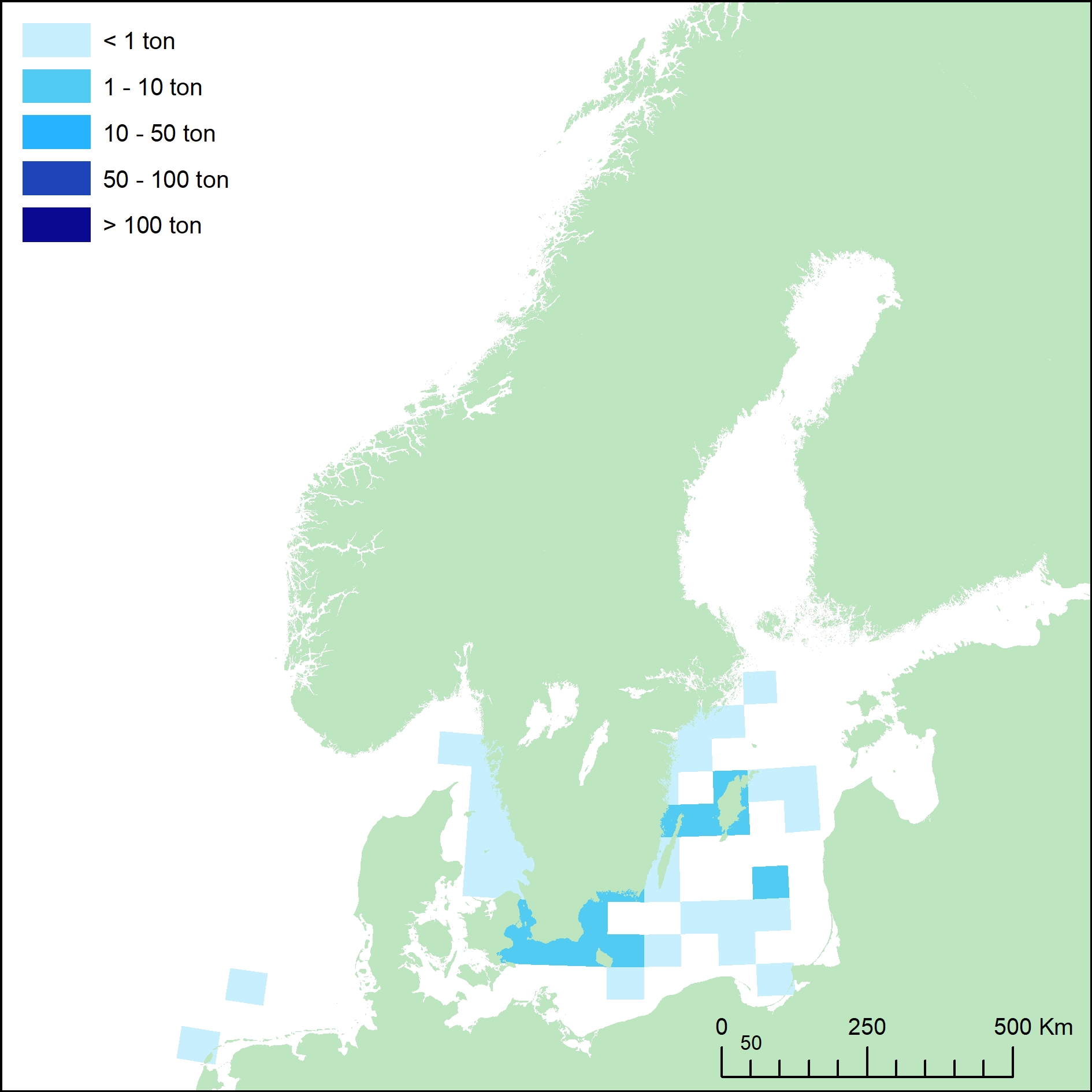
Svenska yrkesfiskares huvudsakliga landningar (ton) av europeisk skrubbskädda 2023 per Ices-rektangel. En Ices-rektangel är cirka 56 km x 56 km stor.
Bestånds- och populationsstruktur
I Östersjön finns två närbesläktade arter av europeisk skrubbskädda, även kallad flundra; skrubbskädda (Platichthys flesus) och östersjöskrubbskädda (Platichthys solemdali)1. Momigliano, P., Jokinen, H., Calboli, F., Aro, E. and Merilä, J. (2019). “Cryptic temporal changes in stock composition explain the decline of a flounder (Platichthys spp.) assemblage.” Evolutionary Applications. https://dx.doi.org/10.1111/eva.127382. Jokinen, H., Momigliano, P. and Merilä, J. (2019). “From ecology to genetics and back: the tale of two flounder species in the Baltic Sea.” ICES Journal of Marine Science 76(7): 2267-2275. https://doi.org/10.1093/icesjms/fsz151. Tidigare ansågs de dock vara två lektyper av samma art (utsjölekande och kustlekande) men även om de överlappar geografiskt och är morfologiskt väldigt lika, har de olika reproduktionsstrategier och korsar sig inte vid lek3. Momigliano, P., Jokinen, H., Fraimout, A., Florin, A. B., Norkko, A. and Merilä, J. (2017). “Extraordinarily rapid speciation in a marine fish.” Proc Natl Acad Sci U S A 114(23): 6074-6079. https://doi.org/10.1073/pnas.1615109114. Momigliano, P., Denys, G., Jokinen, H. and Merilä, J. (2018). “Platichthys solemdali sp. nov. (Actinopterygii, Pleuronectiformes): A New Flounder Species From the Baltic Sea.” Frontiers in Marine Science 5. https://www.frontiersin.org/articles/10.3389/fmars.2018.00225. Nya genetiska studier har bekräftat att de är två olika arter3. Momigliano, P., Jokinen, H., Fraimout, A., Florin, A. B., Norkko, A. and Merilä, J. (2017). “Extraordinarily rapid speciation in a marine fish.” Proc Natl Acad Sci U S A 114(23): 6074-6079. https://doi.org/10.1073/pnas.161510911. Den nya kustlekande arten av europeisk skrubbskädda fick namnet Platichthys solemdali4. Momigliano, P., Denys, G., Jokinen, H. and Merilä, J. (2018). “Platichthys solemdali sp. nov. (Actinopterygii, Pleuronectiformes): A New Flounder Species From the Baltic Sea.” Frontiers in Marine Science 5. https://www.frontiersin.org/articles/10.3389/fmars.2018.00225 och den utsjölekande arten förblir Platichthys flesus. De två arterna skiljer sig inte bara åt genom användandet av olika lekområden utan de har också skillnader i ägg- och spermieegenskaper och även skillnader i tillväxt5. Erlandsson, J., Östman, Ö., Florin, A.-B. and Pekcan-Hekim, Z. (2017). “Spatial structure of body size of European flounder (Platichthys flesus L.) in the Baltic Sea.” Fisheries Research 189: 1-9. https://doi.org/10.1016/j.fishres.2017.01.0016. Nissling, A. and Wallin, I. (2020). “Recruitment variability in Baltic flounder (Platichthys solemdali) – effects of salinity with implications for stock development facing climate change.” Journal of Sea Research 162: 101913. https://doi.org/10.1016/j.seares.2020.1019137. Hemmer-Hansen, J., Nielsen, E. E., Grønkjaer, P. and Loeschcke, V. (2007). “Evolutionary mechanisms shaping the genetic population structure of marine fishes; lessons from the European flounder (Platichthys flesus).” Molecular Ecology 16(15): 3104-3118. https://dx.doi.org/10.1111/j.1365-294x.2007.03367.x8. Florin, A. B. and Höglund, J. (2008). “Population structure of flounder (Platichthys flesus) in the Baltic Sea: differences among demersal and pelagic spawners.” Heredity 101(1): 27-38. https://dx.doi.org/10.1038/hdy.2008.229. Jokinen, H., Wennhage, H., Lappalainen, A., Ådjers, K., Rask, M. and Norkko, A. (2015). “Decline of flounder (Platichthys flesus (L.)) at the margin of the species’ distribution range.” Journal of Sea Research 105: 1-9. https://doi.org/10.1016/j.seares.2015.08.001.
Skrubbskädda (P. flesus) finns i Nordsjön, Skagerrak, Kattegatt, Öresund och Östersjön upp till Ålands hav. Längre norrut är arten mindre vanlig.
Östersjöskrubbskädda (P. solemdali) finns i norra och centrala Östersjön. I de södra delarna av Östersjön är den mindre vanlig och den finns inte i Skagerrak, Kattegatt och Nordsjön.
Internationella havsforskningsrådet (Ices) bedömer i dagsläget att europeisk skrubbskädda i Östersjön är uppdelad i fyra olika bestånd10. ICES (2022). Baltic Fisheries Assessment Working Group (WGBFAS), ICES Scientific Reports. 4:44: 659 pp https://doi.org/10.17895/ices.pub.19793014.v2.: Bälthavet och Öresund (Ices-delområden 22–23, P. flesus), södra Östersjön (består av Arkonabassängen samt Hanöbukten och Bornholmbassängen, Ices-delområden 24–25, Platichthys spp.), östra Östersjön (består av sydöstra Östersjön samt östra gotlandshavet och Rigabukten, Ices-delområden 26 och 28, Platichthys spp.), samt norra Östersjön (består av västra Gotlandshavet, Skärgårdshavet, Bottenhavet, Bottenviken och Finska viken, Ices-delområden 27 och 29–32, P. solemdali). Majoriteten av den skrubbskädda som fångas av Sverige fångas i södra Östersjön och Öresund.
Biologiskt råd för europeisk skrubbskädda i Bälthavet och Öresund
Internationella havsforskningsrådet (Ices)
Ices har ingen rådgivning för europeisk skrubbskädda i Bälthavet och Öresund för 2025.
Ices har inte uppmanats att ge fångstråd för detta bestånd. Det senaste fångstrådet som gavs var 2019 på maximalt 4 030 ton.

ICES råd om fiskemöjligheter i Bälthavet och Öresund.
Biologiskt råd för europeisk skrubbskädda i södra Östersjön
Internationella havsforskningsrådet (Ices)
Ices har ingen rådgivning för europeisk skrubbskädda i södra Östersjön för 2025 och 2026.
Ices har inte uppmanats att ge fångstråd för detta bestånd. Det senaste fångstrådet som gavs var 2019 på maximalt 41 628 ton.
ICES råd om fiskemöjligheter i Södra Östersjön (Ices-delområden 24–25).
Biologiskt råd för europeisk skrubbskädda i östra Östersjön
Internationella havsforskningsrådet (Ices)
Ices har ingen rådgivning för europeisk skrubbskädda i östra Östersjön för 2025 eller 2026.
Ices har inte uppmanats att ge fångstråden för detta bestånd. Det senaste fångstrådet som gavs var 2019 på maximalt 1 617 ton.
ICES råd om fiskemöjligheter i Östra Östersjön (Ices-delområden 26 och 28).
Biologiskt råd för europeisk skrubbskädda i norra Östersjön
Internationella havsforskningsrådet (Ices)
Ices har ingen rådgivning för europeisk skrubbskädda i norra Östersjön för 2025.
Ices har inte uppmanats att ge fångstråd för detta bestånd. Det senaste fångstrådet som gavs var år 2019 på maximalt 395 ton.
ICES råd om fiskemöjligheter i Norra Östersjön (Ices-delområden 27, 29-32).
Biologiskt råd för skrubbskädda i Nordsjön, Skagerrak och Kattegatt
Internationella havsforskningsrådet (Ices)
Ices fångstråd för europeisk skrubbskädda i Nordsjön, Skagerrak och Kattegatt är 864 ton årligen för 2024 och 2025. Om andelen utkast (fisk kastad överbord) inte ändras från genomsnittet för åren 2020–2022, innebär detta landningar på högst 640 ton årligen under 2024 och 2025.
ICES råd om fiskemöjligheter i Nordsjön, Skagerrak och Kattegatt.
Europeisk skrubbskädda 2024
Kustlaboratoriet
Sida publicerad: 8 januari 2025